onsdag den 1. oktober 2008

Statsministeren vs. økonomerne.

Statsminister AFR siger ifl. Ritzau: "Finanskrisen afbødes på kort sigt bedst, hvis USA's Kongres vedtager krisepakken for amerikanske banker med dårlige lån. ..."

Her er han i uoverenstemmelse med en lang række prominente økonomer ved de amerikanske universiteter, der forleden i en fælles udtalelse ytrede:

As economists, we want to express to Congress our great concern for the plan proposed by Treasury Secretary Paulson to deal with the financial crisis. We are well aware of the difficulty of the current financial situation and we agree with the need for bold action to ensure that the financial system continues to function. We see three fatal pitfalls in the currently proposed plan:

1) Its fairness. The plan is a subsidy to investors at taxpayers’ expense. Investors who took risks to earn profits must also bear the losses. Not every business failure carries systemic risk. The government can ensure a well-functioning financial industry, able to make new loans to creditworthy borrowers, without bailing out particular investors and institutions whose choices proved unwise.

2) Its ambiguity. Neither the mission of the new agency nor its oversight are clear. If taxpayers are to buy illiquid and opaque assets from troubled sellers, the terms, occasions, and methods of such purchases must be crystal clear ahead of time and carefully monitored afterwards.

3) Its long-term effects. If the plan is enacted, its effects will be with us for a generation. For all their recent troubles, America's dynamic and innovative private capital markets have brought the nation unparalleled prosperity. Fundamentally weakening those markets in order to calm short-run disruptions is desperately short-sighted.

For these reasons we ask Congress not to rush, to hold appropriate hearings, and to carefully consider the right course of action, and to wisely determine the future of the financial industry and the U.S. economy for years to come.


Den østrigske økonom Robert P. Murphy tilknyttet Von Mises Instituttet er heller ikke begejstret for nu at sige det mildt, han skriver:

The Paulson bailout failed in the House. If it isn't a death blow to the plan, it should be. This is not an economic plan: it is a heist.

It will go down as The Great Bank Robbery of 2008.

The economics behind it are nonsense, but we are naïve if we spend much time even considering the "arguments" for it. This is a money and power grab, pure and simple.

Lidt om Christiania

I forlængelse af at Regeringen via Slots og Ejendomsstyrelsen, har nægtet at give Christianitternes bud på en løsning en chance, er her en lille almen kommentar, som i et større perspektiv også er en kommentar på den drejning samfundet har taget under den DF-opbakkede borgerlige regering....

Det er meget bedrøveligt og ærgerligt at 40-50 pushere kan stjæle så meget opmærksomhed fra en fristad med mellem 2500-3000 indbyggere. Pusherne udgør maksimalt 2 procent af beboerne, men det er altid dem vi hører om når der rapporteres om Christiania i den borgerlige presse og det meste af den øvrige mediedækning. Det er aldrig det faktum at Fristaden i snart 40 år har været vækstcenter for kreativitet og alternativer til mainstream, eller det forhold at Christiania har Danmarks eneste økologisk-vegetariske restaurant udelukkende drevet af frivillige, samt et kunstgalleri, en biograf, fem spillesteder (Rockmaskinen, Grå Hal, Loppen, Operaen og jazzspillestedet Børneteatret) samt adskillige midlertidige udendørsscener som stilles op og pilles ned henover året, plus den faste scene ved Nemoland. På disse har gud og hver mand spillet gennem tiderne, lige fra internationale topnavne til bands der spillede deres første og sidste koncert på Staden, og det alt sammen indenfor en radius af femhundrede meter, hvilket gør Staden til det mest koncentrerede musikkulturelle center i København. Der er udover det nævnte vegetariske spisested Morgenstedet – et multikulturelt mekka i sig selv, både hvad personale og kunder angår – også Spiseloppen, som er bredt kendt for deres kvalitet samt flere take-away boder og steder, som i ånden også er ganske intermistiske, men...

Det Christiania der tidligere var et åndehul for kreative og anderledestænkende sjæle, og for folk der gerne ville kunne befinde sig i byen uden konstant at blive filmet af overvågningskameraer, eller holdt øje med af forbikørende transitter fyldt med betjente, er der desværre kun resterne tilbage af. Regeringen har sammen med politimesteren forvandlet stedet til det mest overvågede sted i byen via den voldsommeste magtdemonstration målt over tid og i resourcer, jeg kan huske at have oplevet i mit liv i hovedstaden. Tolv-femten mand stærke processioner af svært bevæbnede, kampuniformerede betjente, kan flere gange ugentligt ses gå rundt og intimidere de besøgende og beboende med deres tilstedeværelse. Vilkårlige visitationer, præventive midlertidige anholdelser og udspørgelser af ikke-pushende besøgende og beboere er bedrøveligvis hverdagskost, alt sammen pga. af mennesker der i fred og fordragelighed begår offerløs ”kriminalitet”.

Det er meget vanskeligt IKKE at se denne ekstremt disproportionelle magtudøvelse - som de facto udgør en politistat i staten - som en politisk hetz-kampagne fuldstændig bevidst bedrevet af en regering bestående af et hold borgerlige politikere, som over årene har haft ekstremt ondt i røven over fristaden. Den nye “vi kan på ingen måder forhandle med jer”-udmelding hælder blot benzin på denne mistankes bål. Interessant og ganske paradoksalt er det da også i denne sammenhæng at flokkens leder, Anders Fogh Rasmussen, i forordet til demokratikanonen skriver, at friheden skal udvikles og vindes i hver ny generation. Det gælder åbenbart ikke Christiania.

tirsdag den 30. september 2008

Citatcentralen - Rolling Stones journalist Matt Taibbi om USA og Palin.

Not only is Sarah Palin a fraud, she's the tawdriest, most half-assed fraud imaginable, 20 floors below the lowest common denominator, a character too dumb even for daytime TV -and this country is going to eat her up, cheering her every step of the way. All because most Americans no longer have the energy to do anything but lie back and allow ourselves to be jacked off by the calculating thieves who run this grasping consumer paradise we call a nation.

søndag den 28. september 2008

USAs storhedstid er forbi

A shattering moment in America's fall from power

The global financial crisis will see the US falter in the same way the Soviet Union did when the Berlin Wall came down. The era of American dominance is over.

Our gaze might be on the markets melting down, but the upheaval we are experiencing is more than a financial crisis, however large. Here is a historic geopolitical shift, in which the balance of power in the world is being altered irrevocably. The era of American global leadership, reaching back to the Second World War, is over.

You can see it in the way America's dominion has slipped away in its own backyard, with Venezuelan President Hugo Chávez taunting and ridiculing the superpower with impunity. Yet the setback of America's standing at the global level is even more striking. With the nationalisation of crucial parts of the financial system, the American free-market creed has self-destructed while countries that retained overall control of markets have been vindicated. In a change as far-reaching in its implications as the fall of the Soviet Union, an entire model of government and the economy has collapsed.

Ever since the end of the Cold War, successive American administrations have lectured other countries on the necessity of sound finance. Indonesia, Thailand, Argentina and several African states endured severe cuts in spending and deep recessions as the price of aid from the International Monetary Fund, which enforced the American orthodoxy. China in particular was hectored relentlessly on the weakness of its banking system. But China's success has been based on its consistent contempt for Western advice and it is not Chinese banks that are currently going bust. How symbolic yesterday that Chinese astronauts take a spacewalk while the US Treasury Secretary is on his knees.

Despite incessantly urging other countries to adopt its way of doing business, America has always had one economic policy for itself and another for the rest of the world. Throughout the years in which the US was punishing countries that departed from fiscal prudence, it was borrowing on a colossal scale to finance tax cuts and fund its over-stretched military commitments. Now, with federal finances critically dependent on continuing large inflows of foreign capital, it will be the countries that spurned the American model of capitalism that will shape America's economic future.

Which version of the bail out of American financial institutions cobbled up by Treasury Secretary Hank Paulson and Federal Reserve chairman Ben Bernanke is finally adopted is less important than what the bail out means for America's position in the world. The populist rant about greedy banks that is being loudly ventilated in Congress is a distraction from the true causes of the crisis. The dire condition of America's financial markets is the result of American banks operating in a free-for-all environment that these same American legislators created. It is America's political class that, by embracing the dangerously simplistic ideology of deregulation, has responsibility for the present mess.

In present circumstances, an unprecedented expansion of government is the only means of averting a market catastrophe. The consequence, however, will be that America will be even more starkly dependent on the world's new rising powers. The federal government is racking up even larger borrowings, which its creditors may rightly fear will never be repaid. It may well be tempted to inflate these debts away in a surge of inflation that would leave foreign investors with hefty losses. In these circumstances, will the governments of countries that buy large quantities of American bonds, China, the Gulf States and Russia, for example, be ready to continue supporting the dollar's role as the world's reserve currency? Or will these countries see this as an opportunity to tilt the balance of economic power further in their favour? Either way, the control of events is no longer in American hands.

The fate of empires is very often sealed by the interaction of war and debt. That was true of the British Empire, whose finances deteriorated from the First World War onwards, and of the Soviet Union. Defeat in Afghanistan and the economic burden of trying to respond to Reagan's technically flawed but politically extremely effective Star Wars programme were vital factors in triggering the Soviet collapse. Despite its insistent exceptionalism, America is no different. The Iraq War and the credit bubble have fatally undermined America's economic primacy. The US will continue to be the world's largest economy for a while longer, but it will be the new rising powers that, once the crisis is over, buy up what remains intact in the wreckage of America's financial system.

There has been a good deal of talk in recent weeks about imminent economic armageddon. In fact, this is far from being the end of capitalism. The frantic scrambling that is going on in Washington marks the passing of only one type of capitalism - the peculiar and highly unstable variety that has existed in America over the last 20 years. This experiment in financial laissez-faire has imploded.While the impact of the collapse will be felt everywhere, the market economies that resisted American-style deregulation will best weather the storm. Britain, which has turned itself into a gigantic hedge fund, but of a kind that lacks the ability to profit from a downturn, is likely to be especially badly hit.

The irony of the post-Cold War period is that the fall of communism was followed by the rise of another utopian ideology. In American and Britain, and to a lesser extent other Western countries, a type of market fundamentalism became the guiding philosophy. The collapse of American power that is underway is the predictable upshot. Like the Soviet collapse, it will have large geopolitical repercussions. An enfeebled economy cannot support America's over-extended military commitments for much longer. Retrenchment is inevitable and it is unlikely to be gradual or well planned.

Meltdowns on the scale we are seeing are not slow-motion events. They are swift and chaotic, with rapidly spreading side-effects. Consider Iraq. The success of the surge, which has been achieved by bribing the Sunnis, while acquiescing in ongoing ethnic cleansing, has produced a condition of relative peace in parts of the country. How long will this last, given that America's current level of expenditure on the war can no longer be sustained?

An American retreat from Iraq will leave Iran the regional victor. How will Saudi Arabia respond? Will military action to forestall Iran acquiring nuclear weapons be less or more likely? China's rulers have so far been silent during the unfolding crisis. Will America's weakness embolden them to assert China's power or will China continue its cautious policy of 'peaceful rise'? At present, none of these questions can be answered with any confidence. What is evident is that power is leaking from the US at an accelerating rate. Georgia showed Russia redrawing the geopolitical map, with America an impotent spectator.

Outside the US, most people have long accepted that the development of new economies that goes with globalisation will undermine America's central position in the world. They imagined that this would be a change in America's comparative standing, taking place incrementally over several decades or generations. Today, that looks an increasingly unrealistic assumption.

Having created the conditions that produced history's biggest bubble, America's political leaders appear unable to grasp the magnitude of the dangers the country now faces. Mired in their rancorous culture wars and squabbling among themselves, they seem oblivious to the fact that American global leadership is fast ebbing away. A new world is coming into being almost unnoticed, where America is only one of several great powers, facing an uncertain future it can no longer shape.

Hele Michael Moores nys film Slacker Uprising!

Law Enforcement AGAINST Prohibition

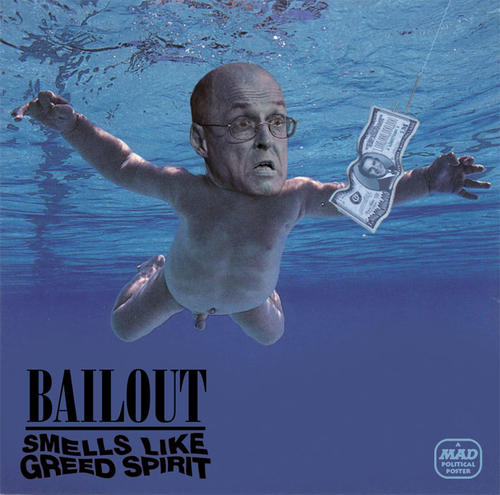
Politisk Satire: Smells like greed spirit.

lørdag den 27. september 2008

Ralph Nader - Kandidaten der ties ihjel af medierne

Nu er medierne jo en ganske potent magtfaktor i ethvert valg da de simpelthen vælger hvem der får taletid, samt hvordan kandidaterne fremstilles bla. via de spørgsmål man fra journalisternes side stiller kandidaterne. I USA findes der, som de fleste nok allerede er bekendt med, en tredje kandidat ved navn Ralph Nader, men udfra den televiserede mediedækning at dømme skulle man ikke tro det var tilfældet, hvilket har fået Nader til at kalde USA for et to-partis diktatur. Her er hvad manden og hans running mate mener bør gøres.

Wall Street Bailout.


Rusland/Georgien Konflikten.


Nader første hundrede dage i Det Hvide Hus.

Bill Clinton om Finanskrisen

Lykkebergs Kritik af Narcissistkulturen

Informations yngste intellektuelle samfundsrevser, den som regel veloplagte, skarpe og interessante Rune Lykkeberg har i dagens Information en ganske rammende kritik af det overfladiske samfunds / narcissistkulturen.

Overskud og underskud.

Slavoj Žižek - Democracy Now Interview.


Ahmadinejad's tale i FN d. 24-9-2008


KLIK

Obama-McCain Første Tv-Duel

Transkription af TV-Duellen


torsdag den 25. september 2008

Forbes udgiver liste over 400 rigeste amerikanere.

By Tom Eley 24/09/08 "WSWS"

Even as the US careens into its greatest economic calamity since the Great Depression, the financial aristocracy whose parasitism and criminality has brought on the crisis has held its own—and then some.

The recently released Forbes 400 list of the richest Americans shows that the combined wealth of the aristocracy has increased 2 percent, even amidst the financial breakdown and recession of the economy. “In this, the 27th edition of the list,” Forbes glumly notes, “the assembled net worth of America’s wealthiest rose by $30 billion—only 2%—to $1.57 trillion.”

Readers will be forgiven for tripping over the word “only” in relationship to a $30 billion increase in wealth for 400 spectacularly wealthy individuals. This “modest” figure—the increase in wealth for the oligarchy in a bad year—is only slightly less than the federal government has budgeted for unemployment insurance for all of 2008.

The overall wealth of the 400 richest Americans is staggering. There are no multimillionaires on the list; a minimum of $1.3 billion being required to gain admittance, while the average net worth is $3.9 billion.

The combined wealth of the richest 400 individuals is $400 billion more than the entire discretionary spending budget for the federal government. It is more than $300 billion larger than the combined 2008 outlay for Social Security, Medicare, and Medicaid. It is more than 15 times the combined appropriations for education and highways and mass transit.

The personal wealth of the top 400 Americans is more than twice the combined annual GDP of all of sub-Saharan Africa, home to nearly 800 million people, the vast majority of whom live in dire conditions. It is also several hundred billion dollars larger than the GDP of the world’s eighth biggest economy, that of Spain.

The club’s richest member is Microsoft magnate Bill Gates, whose net worth, $57 billion, is greater than the annual GDP of about 120 of the world’s 180 nations.

The year’s biggest winner is New York City Mayor Michael Bloomberg, whose personal wealth increased by $8.5 billion to $20 billion, making Bloomberg the nation’s eighth richest individual.

On Tuesday, without a hint of irony—much less shame—Mayor Bloomberg proposed brutal across-the-board budget cuts for the city of New York. He is calling for cutbacks totaling $500 million for the current fiscal year, to be followed by much steeper cuts in the coming years. Meanwhile Bloomberg, in the course of just one year, pocketed 17 times what he is now demanding that millions of working people in New York City forfeit in terms of vital services and jobs. Only in America!

However, owing to the turbulence of the stock market, great fortunes were being both made and squandered even as Forbes published its list. “The Forbes 400 is a snapshot of estimated wealth on Aug. 29, 2008, the day we locked in prices of publicly traded stocks,” the magazine wrote. “Given how unsettled the stock market is, some of those on our list will become significantly richer or poorer within weeks—even days—of publication. Many, including AIG shareholders Eli Broad and Steven Udvar-Hazy, have lost hundreds of millions of dollars.”

Becoming poorer is of course a relative process; we can be certain that none of the demoted oligarchs faces hunger.

Among this year’s biggest “losers”—and there is a degree of poetic justice in this—are casino moguls. Kirk Kerkorian has managed to squander $6.8 billion of ill-gotten social wealth, while the fortune of his rival Sheldon Adelson “has fallen $13 billion in the past 12 months—$1.5 million per hour.” Adelson has managed to lose more in an hour than most US workers will earn in a lifetime.

That the nation’s financial aristocracy continues to gorge itself even as the economy stagnates demonstrates the increasing parasitism of the elite. The wealth of the super-rich is no longer bound up with the growth of the real economy, as it was in the days of Carnegie, Rockefeller, and Ford. Just the opposite is the case. The wealth of the aristocracy is based on the plundering and destruction of the real economy.

A perusal of the basis of the Forbes 400 members’ wealth illustrates the parasitic nature of US capitalism. The largest two categories on the list are “finance” with 65 members and “investments” with 51. Among the “sources” Forbes lists for these categories are “leveraged buyouts,” “investments,” “hedge funds,” “money management,” and “banking, insurance.”

The next largest category is “media/entertainment,” with 36 representatives among the Fortune 400, followed by the 35 members in the highly toxic “real estate” category. There are 30 members of the Fortune 400 who have reaped their fortunes from “technology,” almost all from Internet ventures or computer technology. Twenty-eight more are found in the “oil/gas” category.

Among the Fortune 400 there are 20 in the “retail” group, among them seven members of the Walton clan, owners of Wal-Mart, who collectively have assets of over $100 billion.

It has to be asked: Are there any members of the Forbes 400 actually associated with producing commodities or creating wealth of some sort?

There are only 19 members of the 400 in the category called “manufacturing.” However, upon inspection we see that this group is comprised of corporate raiders, oil refiners, inheritors, and controllers of holding companies. Only five members of this classification are actually associated with producing a commodity—and four of these produce light consumer goods.

Likewise, there are only 11 members of the financial aristocracy whose wealth has been associated with commodity production in the agricultural sector. But among these, nine are inheritors of the Cargill fortune. Of the other two, one has gained his fortune selling discount cigarettes; another by producing pesticides in Argentina.

There are nine members of the group in the “apparel” category, which is split between those whose wealth has come from retail sales, such as the owners of the Gap clothing stores, and those who have made windfalls by producing consumer goods in low-cost countries and selling the products for inflated prices in the US, such as Phil Knight of Nike.

There is only one member of the “construction/engineering” category, the 321st richest American, Alfred Clark, who has made his fortune by building sports stadiums. The “food” category, of which there are 21 members, is divided among retailers, inheritors, and the owners of single product lines, including the owner of the Slim-Fast empire. There are only three members of the “shipping/trucking/transport” category, and one member of “mining/lumber” (whose wealth came from overseas ventures).

In short, the incredible fortunes accumulated by the American elite have precious little to do with socially useful production. On the contrary, the financial aristocracy has reaped its obscene piles of wealth from the gutting of infrastructure, the shuttering of industrial production, and the impoverishment of working people, the broad mass of the population.

McDeregulation

tirsdag den 23. september 2008

Markedsspillet - En Gravalvorlig Pengeleg

The world's most powerful instrument of governance is not a government. Nor is it a global corporation. Rather it is a global financial system that is running dangerously out of control.

Each day half a million to a million people--primarily Western Europeans, North Americans, and Japanese--arise as dawn reaches their part of the world, turn on their computers, and leave the real world of people, things, and nature to immerse themselves in playing the world's most lucrative computer game: the money game. As their computers come on line, they enter a world of cyberspace constructed of numbers that represent money and complex rules by which those numbers can be converted into a seemingly infinite variety of financial instruments, each with its own distinctive risks and reproductive qualities. Through their interactions, the players engage in competitive transactions aimed at acquiring for their own accounts the money that other players hold.

Players can also pyramid the amount of money in play by borrowing from one another and bidding up prices. Indeed, the money game players have been so successful in creating play money that for every $1 now circulating in the productive world economy of real goods and services, it is estimated that there is $20 to $50 circulating in the world of pure finance--"investment" funds completely delinked from the creation of real value. In the international currency markets alone, some $800 billion to $1 trillion changes hands each day--unrelated to productive investment or trade in actual goods and services.

Not only is the money game challenging and fun, the play money it generates can be exchanged for real money to buy things from people who work in the real world--lots of things. Unfortunately for the rest of us, though it is played like a game and the transactions involve nothing more than moving numbers from one electronic account to another through a global web of computers, the money game has enormous real consequences.


Ovenstående er sakset fra økonomen David Korten's bog "When Corporations Rule The World".

A note of appreciation from the rich

Let's be honest: you'll never win the lottery.

On the other hand, the chances are pretty good that you'll slave away at some miserable job the rest of your life. That's because you were in all likelihood born into the wrong social class. Let's face it -- you're a member of the working caste. Sorry!

As a result, you don't have the education, upbringing, connections, manners, appearance, and good taste to ever become one of us. In fact, you'd probably need a book the size of the yellow pages to list all the unfair advantages we have over you. That's why we're so relieved to know that you still continue to believe all those silly fairy tales about "justice" and "equal opportunity" in America.

Of course, in a hierarchical social system like ours, there's never been much room at the top to begin with. Besides, it's already occupied by us -- and we like it up here so much that we intend to keep it that way. But at least there's usually someone lower in the social hierarchy you can feel superior to and kick in the teeth once in a while. Even a lowly dishwasher can easily find some poor slob further down in the pecking order to sneer and spit at. So be thankful for migrant workers, prostitutes, and homeless street people.

Always remember that if everyone like you were economically secure and socially privileged like us, there would be no one left to fill all those boring, dangerous, low-paid jobs in our economy. And no one to fight our wars for us, or blindly follow orders in our totalitarian corporate institutions. And certainly no one to meekly go to their grave without having lived a full and creative life. So please, keep up the good work!

You also probably don't have the same greedy, compulsive drive to possess wealth, power, and prestige that we have. And even though you may sincerely want to change the way you live, you're also afraid of the very change you desire, thus keeping you and others like you in a nervous state of limbo. So you go through life mechanically playing your assigned social role, terrified what others would think should you ever dare to "break out of the mold."

Naturally, we try to play you off against each other whenever it suits our purposes: high-waged workers against low-waged, unionized against non-unionized, Black against White, male against female, American workers against Japanese against Mexican against.... We continually push your wages down by invoking "foreign competition," "the law of supply and demand," "national security," or "the bloated federal deficit." We throw you on the unemployed scrap heap if you step out of line or jeopardize our profits. And to give you an occasional break from the monotony of our daily economic blackmail, we allow you to participate in our stage-managed electoral shell games, better known to you ordinary folks as "elections." Happily, you haven't a clue as to what's really happening -- instead, you blame "Aliens," "Tree-hugging Environmentalists," "Niggers," "Jews," Welfare Queens," and countless others for your troubled situation.

We're also very pleased that many of you still embrace the "work ethic," even though most jobs in our economy degrade the environment, undermine your physical and emotional health, and basically suck your one and only life right out of you. We obviously don't know much about work, but we're sure glad you do!

Of course, life could be different. Society could be intelligently organized to meet the real needs of the general population. You and others like you could collectively fight to free yourselves from our domination. But you don't know that. In fact, you can't even imagine that another way of life is possible. And that's probably the greatest, most significant achievement of our system -- robbing you of your imagination, your creativity, your ability to think and act for yourself.

So we'd truly like to thank you from the bottom of our heartless hearts. Your loyal sacrifice makes possible our corrupt luxury; your work makes our system work. Thanks so much for "knowing your place" -- without even knowing it!

http://www.informationclearinghouse.info/article20833.htm